Overview
AI companies face a specific fundraising challenge: investors in this space are technically sophisticated, move fast, and have already seen hundreds of pitches. A generic startup template signals immediately that a founder doesn’t understand what makes an AI business different – high average contract values, enterprise sales cycles, GPU compute as a significant cost line, proprietary data as a moat, and NRR as the north star metric. This package is built specifically for AI founders who need investor-ready documents that reflect the economics investors in this space actually care about.
What is it?
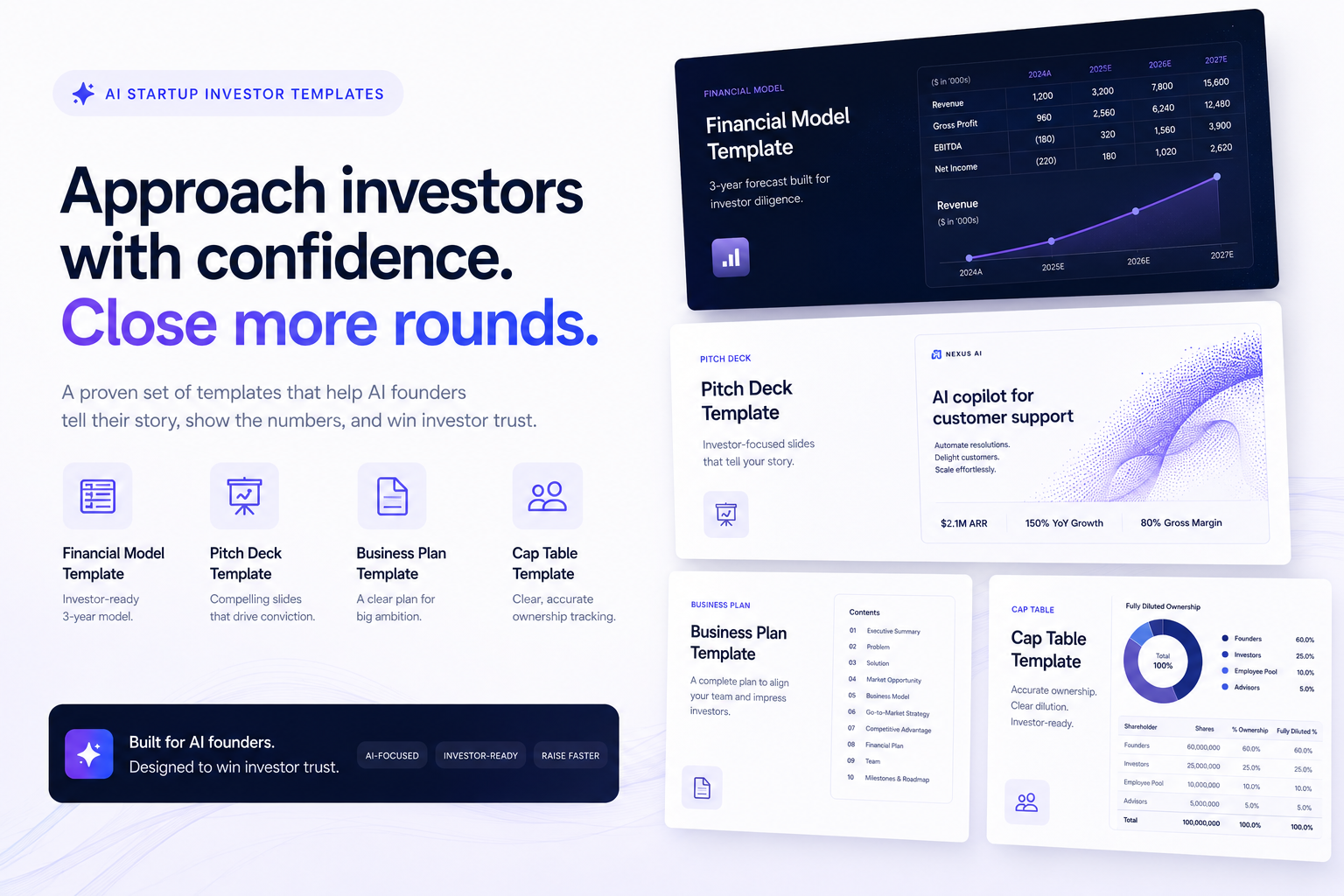
A complete fundraising document package for AI and enterprise software startups, containing four investor-ready templates: a pitch deck structured for AI company narratives, a 5-year financial model calibrated for enterprise ACV and compute-heavy COGS, a business plan that covers regulatory, IP, and model development considerations, and a cap table covering Seed and Series A scenarios. All documents speak the same language – the language AI investors use.
What’s in the package
| Pitch Deck Template | 5-Year Financial Model | Business Plan Template | Cap Table Template |
| 19-slide AI investor deck | Enterprise ACV model | AI-specific 12 sections | Seed + Series A scenarios |
| LLM/AI narrative structure | Compute cost modelling | IP & data moat section | ESOP pool modelling |
| Enterprise sales storyline | NRR & expansion revenue | Regulatory framework | Dilution calculator |
| Instant download | Instant download | Instant download | Instant download |
Who is this for?
Pre-seed and Seed-stage founders building enterprise AI software, vertical AI tools, LLM-powered platforms, domain-specific automation, or AI-native SaaS products. Also suitable for AI founders preparing Series A materials with an updated investor narrative.
Why is this different from other templates?
AI investors are among the most analytically rigorous in the venture market. They look for founders who understand the unit economics of AI – not just the technology. This package is structured around the specific questions AI investors ask: How does gross margin evolve as compute costs fall? What is the proprietary data moat? What does NRR look like at scale? What does the enterprise sales motion cost? Your documents need to answer these questions before the investor has to ask them.
What each document contains
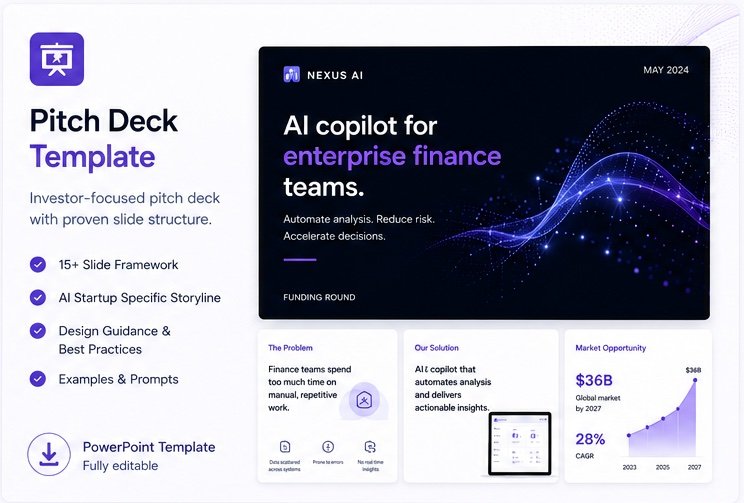
📊 AI Pitch Deck Template
A 19-slide deck structured for AI company fundraising narratives: the problem of manual, inefficient knowledge work; the AI solution and its accuracy advantage; proprietary data as a moat; enterprise ACV and sales motion; gross margin trajectory; NRR story; team with ML credentials; funding ask and use of proceeds. Fully editable in PowerPoint.
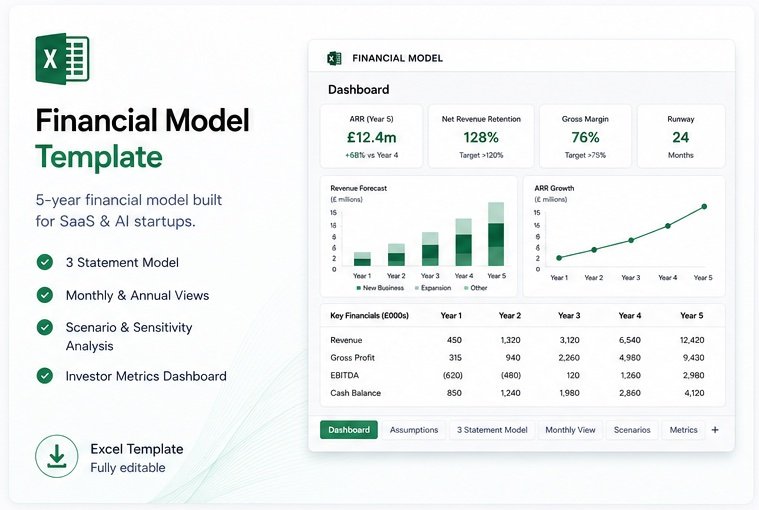
📈 AI Financial Model
A 22-sheet Excel model structured for AI company economics: enterprise customer count and ACV as the revenue driver, compute and infrastructure costs in COGS, SOC 2 and compliance costs in overheads, ML engineering team in the staffing plan, and a gross margin progression story built into the 5-year P&L. All assumptions adjustable in the Build Sheet.
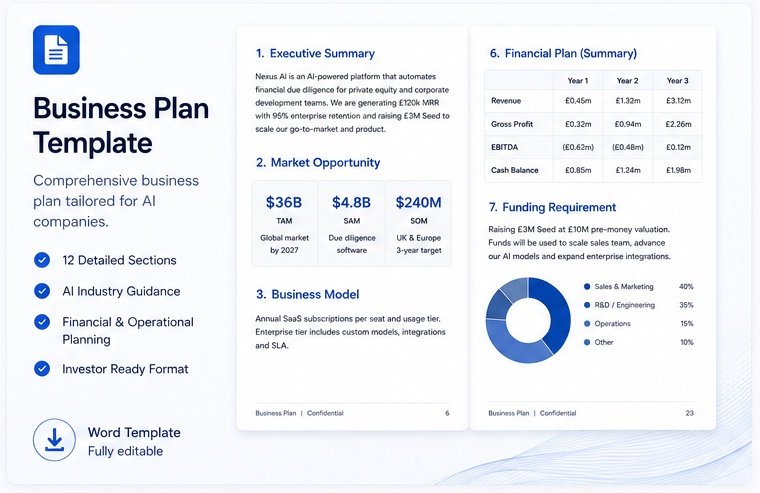
📄 AI Business Plan
A 12-section business plan covering AI-specific considerations throughout: proprietary data strategy, model accuracy benchmarking, LLM provider dependency risk, SOC 2 and enterprise security roadmap, AI regulatory landscape (EU AI Act, GDPR), patent and trade secret IP strategy, enterprise sales cycle assumptions, and NRR as the key financial KPI.
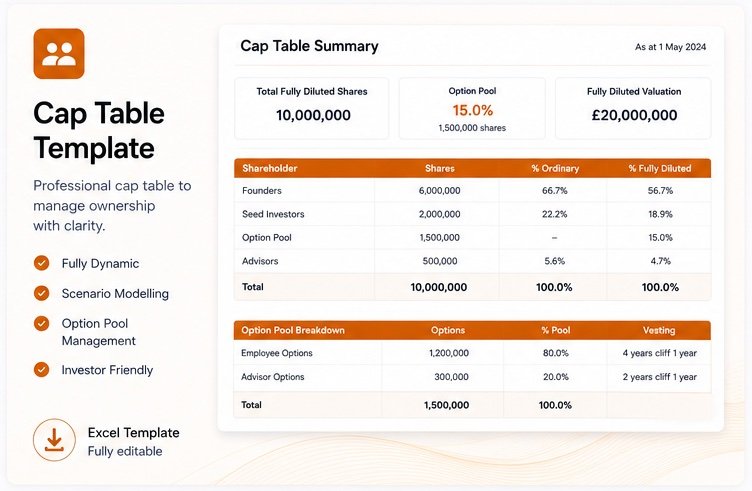
📋 Cap Table Template
A cap table structured for AI company equity rounds: founder shares, early angel round, Seed round with SEIS/EIS modelling, Series A with new investor pool, ESOP for ML engineering talent retention, and post-money valuation at each round. Includes a dilution waterfall.
Format & delivery
All four documents delivered as instant downloads: PowerPoint (.pptx), Excel (.xlsx), Word (.docx), and Excel (.xlsx). Compatible with Microsoft Office 2016+, Google Workspace.
FAQ Section
Add as accordion or text block at the bottom of the product page. Each question targets a specific long-tail search query.
Why is there a separate AI version rather than the generic package?
AI companies have fundamentally different economics – enterprise ACV rather than consumer pricing, GPU compute as a significant COGS line, NRR as the primary growth driver, and proprietary data as the moat. All four documents in the AI package are structured around these dynamics so you spend time on your specific numbers, not reformatting a generic template.
Does the financial model account for LLM API costs?
Yes. The IT and cloud infrastructure cost lines in the model’s overhead structure are designed to accommodate GPU compute, LLM API inference costs, and cloud hosting at scale. You adjust these to your specific API usage and compute spend in the Build Sheet.
Is the pitch deck suitable for both vertical AI and horizontal AI platforms?
Yes. The deck is structured around the core AI investment thesis – domain advantage, accuracy, proprietary data, enterprise sales motion – which applies to both vertical AI (legal AI, healthcare AI, fintech AI) and horizontal platforms. You adapt the specific use case language to your product.
Does the business plan cover the EU AI Act?
The business plan includes a regulatory compliance section that covers the AI regulatory landscape including the EU AI Act and relevant GDPR considerations for AI systems. You adapt this to your specific jurisdictions and product risk classification.
Can I use this package for a pre-revenue AI company?
Yes. All four documents are designed for pre-revenue and early-revenue stages. The financial model projects forward from your starting assumptions. The pitch deck and business plan include guidance on how to frame the investment case before commercial traction.
Disclaimer
- Get it checked. Before you send any document produced from these templates to an investor, lender, or adviser — have a qualified accountant or solicitor review it. These are templates, not finished documents, and the responsibility for what goes in them is yours.
- We are not liable for how you use it. If a projection is wrong, an assumption is incorrect, or a document does not achieve the outcome you hoped for, that is not our liability. The templates are frameworks. The content is yours.
- One purchase, one user. You have bought a licence to use this template for yourself. You may not share it, resell it, or distribute it to others. Each person or business using a template should purchase their own licence.