Overview
B2B SaaS investors speak a specific language: ARR, NRR, CAC payback, Magic Number, gross margin, and Rule of 40. When a founder walks into a SaaS investor meeting with a generic financial model that shows ‘Revenue’ as a single line – no ARR build, no NRR, no unit economics – it signals immediately that they haven’t yet internalised how SaaS businesses are valued. This package is built specifically for B2B SaaS founders who need investor documents that are structured around the metrics investors actually use to evaluate their business.
What is it?
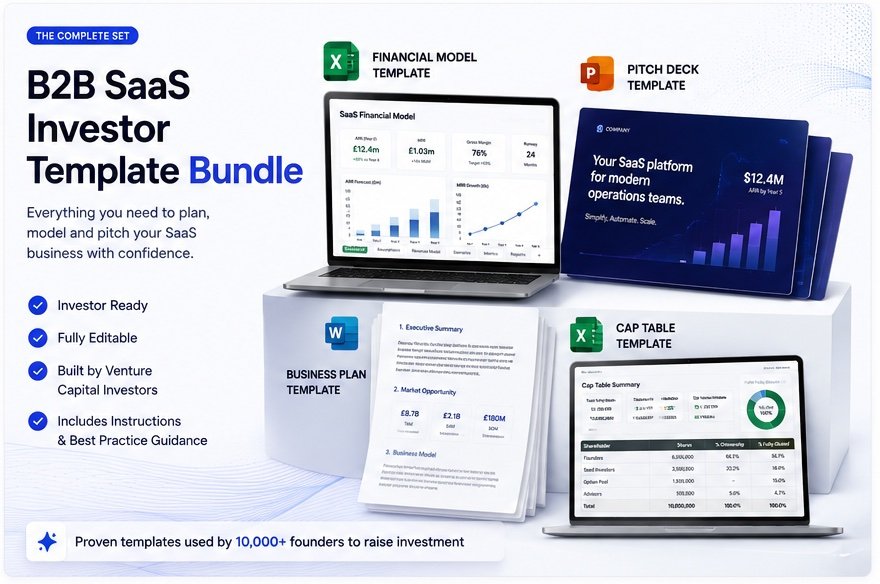
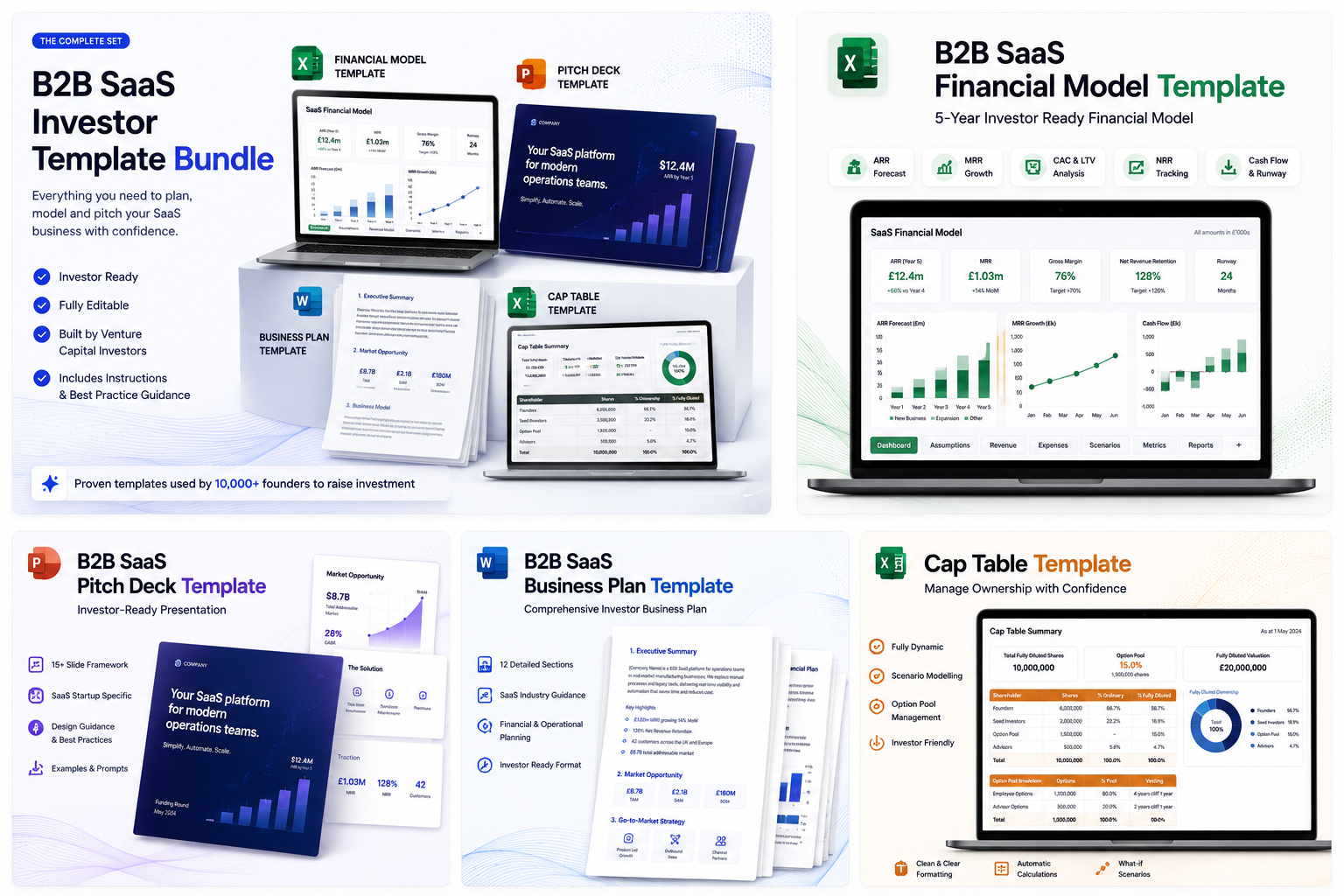
A complete fundraising document package for B2B SaaS and vertical software startups, containing four investor-ready templates: a pitch deck built around the SaaS investment thesis, a 5-year financial model structured for ACV and ARR growth, a business plan covering SaaS GTM and NRR strategy, and a cap table covering Seed, Series A, and ESOP scenarios.
What’s in the package
| Pitch Deck Template | 5-Year Financial Model | Business Plan Template | Cap Table Template |
| 19-slide SaaS investor deck | ARR & ACV model | SaaS-specific 12 sections | Seed + Series A scenarios |
| GTM & sales motion narrative | NRR expansion model | Customer success strategy | ESOP for engineering team |
| Enterprise sales storyline | CAC payback calculation | SOC 2 compliance roadmap | Dilution waterfall |
| Instant download | Instant download | Instant download | Instant download |
Who is this for?
Founders of B2B SaaS, vertical software, workflow automation, no-code/low-code, or enterprise platform businesses at pre-seed through to Series A. Also suitable for SaaS founders updating their investor materials ahead of a follow-on round with new ARR and NRR data.
Why is this different from other templates?
SaaS investors benchmark every business they see against a mental model of what good SaaS looks like at each stage. A Seed-stage SaaS company with £50k MRR should have certain NRR, gross margin, and CAC payback characteristics. A Series A company with £500k ARR has different benchmarks. This package is structured around those benchmarks – so your pitch deck, financial model, business plan, and cap table all tell a consistent, credible story at the stage you’re actually at.
What each document contains
📊 B2B SaaS Pitch Deck Template
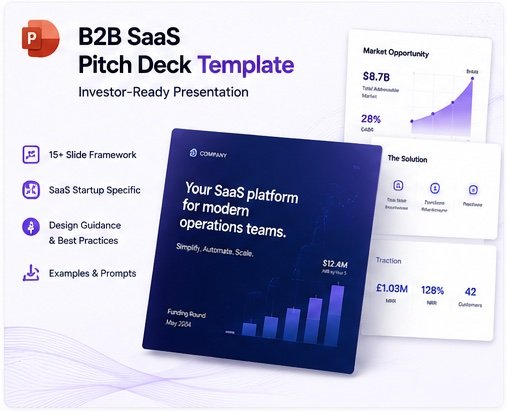
A 19-slide deck structured for SaaS fundraising: the workflow problem and legacy software gap, your modern SaaS solution and deployment speed advantage, ACV and pricing model, NRR story and expansion mechanism, total addressable market with bottom-up sizing, competition analysis with positioning matrix, sales motion (PLG vs sales-led), team with domain and commercial credentials, traction metrics (ARR, MoM growth, NRR, logo count), and funding ask with milestone commitments. Fully editable in PowerPoint.
📈 B2B SaaS Financial Model
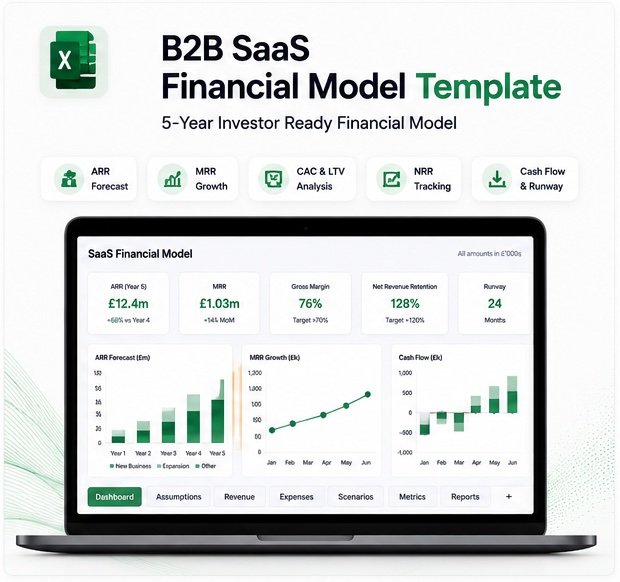
A 22-sheet Excel model structured for SaaS economics: customer count and ACV as the revenue driver, low COGS reflecting software hosting and support, a strong sales and marketing overhead structure, SOC 2 and compliance costs built into the overhead model, customer success team in the staffing plan, and a 5-year ARR build showing the path to Series A metrics. All assumptions adjustable in the Build Sheet.
📄 B2B SaaS Business Plan
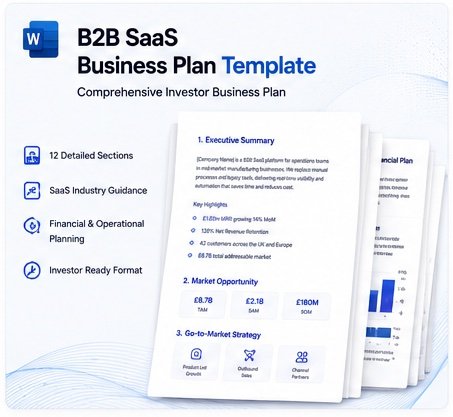
A 12-section business plan covering SaaS-specific considerations throughout: ideal customer profile (ICP) definition, product-led growth vs sales-led GTM strategy, customer success and NRR expansion playbook, integration ecosystem and switching cost strategy, SOC 2 / ISO 27001 compliance roadmap, partner and channel programme, pricing strategy and tier design, and comparable SaaS company exit multiples (ARR-based).
📋 Cap Table Template
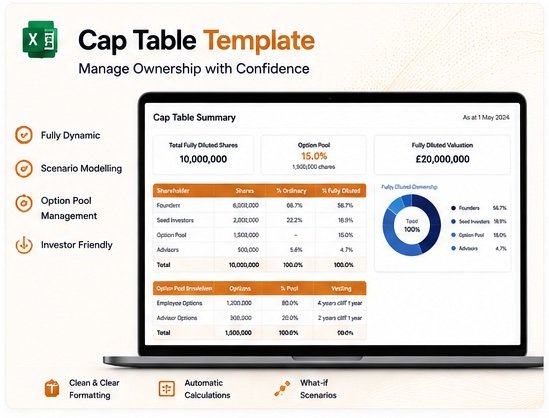
A cap table structured for SaaS equity rounds: founder shares, angel or pre-seed round, Seed round with SEIS/EIS modelling, Series A with new investor pool, ESOP sized for engineering and commercial talent, and a dilution waterfall showing founder ownership at each stage. Includes post-money valuation and ARR multiple at each round.
Format & delivery
All four documents delivered as instant downloads: PowerPoint (.pptx), Excel (.xlsx), Word (.docx), and Excel (.xlsx). Compatible with Microsoft Office 2016+, Google Workspace.
FAQ Section
Add as accordion or text block at the bottom of the product page. Each question targets a specific long-tail search query.
Why do I need a SaaS-specific package rather than a generic startup bundle?
SaaS investors evaluate businesses on ARR, NRR, gross margin, and CAC payback – metrics that don’t appear in generic startup templates. A financial model that shows ‘Revenue’ as a single line, with no ARR build or NRR, immediately signals to a SaaS investor that the founder doesn’t understand SaaS unit economics. All four documents in this package are structured around the metrics SaaS investors actually use.
Does the financial model produce ARR and NRR outputs?
The financial model is built around customer count and ACV, which produces the ARR build that SaaS investors expect. NRR and CAC payback can be derived from the revenue and customer acquisition cost inputs in the model. We include guidance on how to calculate and present these metrics.
Is this suitable for a PLG (product-led growth) business?
Yes. The pitch deck includes a PLG vs sales-led GTM framing, and the financial model can be configured to reflect PLG growth curves with higher initial user counts and lower initial ACV that expands over time. The business plan includes a section on PLG acquisition strategy.
What if my SaaS business has usage-based pricing?
Set the Average Revenue per Customer in the Build Sheet to reflect your blended revenue per customer per year based on actual or projected usage. The model is flexible to subscription, usage-based, and hybrid pricing architectures.
Does the cap table include an ESOP pool?
Yes. The cap table includes an employee share option pool sized for a typical SaaS company at Seed and Series A stage. You can adjust the pool size to reflect your specific retention and incentive strategy.