Overview
Fintech investors are among the most financially literate in the venture ecosystem. They know immediately whether a founder understands the difference between gross revenue and net revenue, whether regulatory capital is included in the funding ask, and whether the credit loss provision is realistic. A generic startup template that treats revenue as a single line and ignores regulatory costs signals precisely the opposite of founder sophistication. This package is built specifically for fintech founders who need investor documents that reflect the true economics of regulated financial products.
What is it?
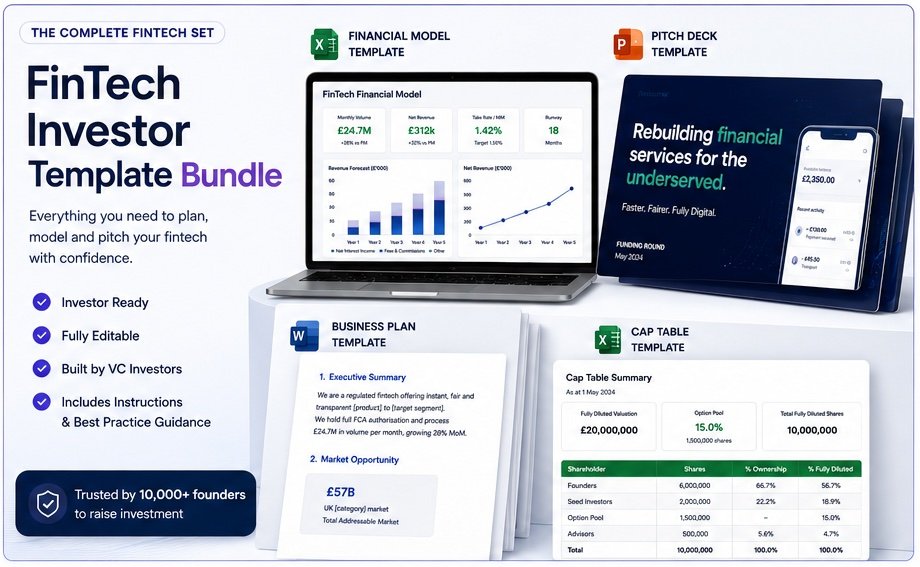
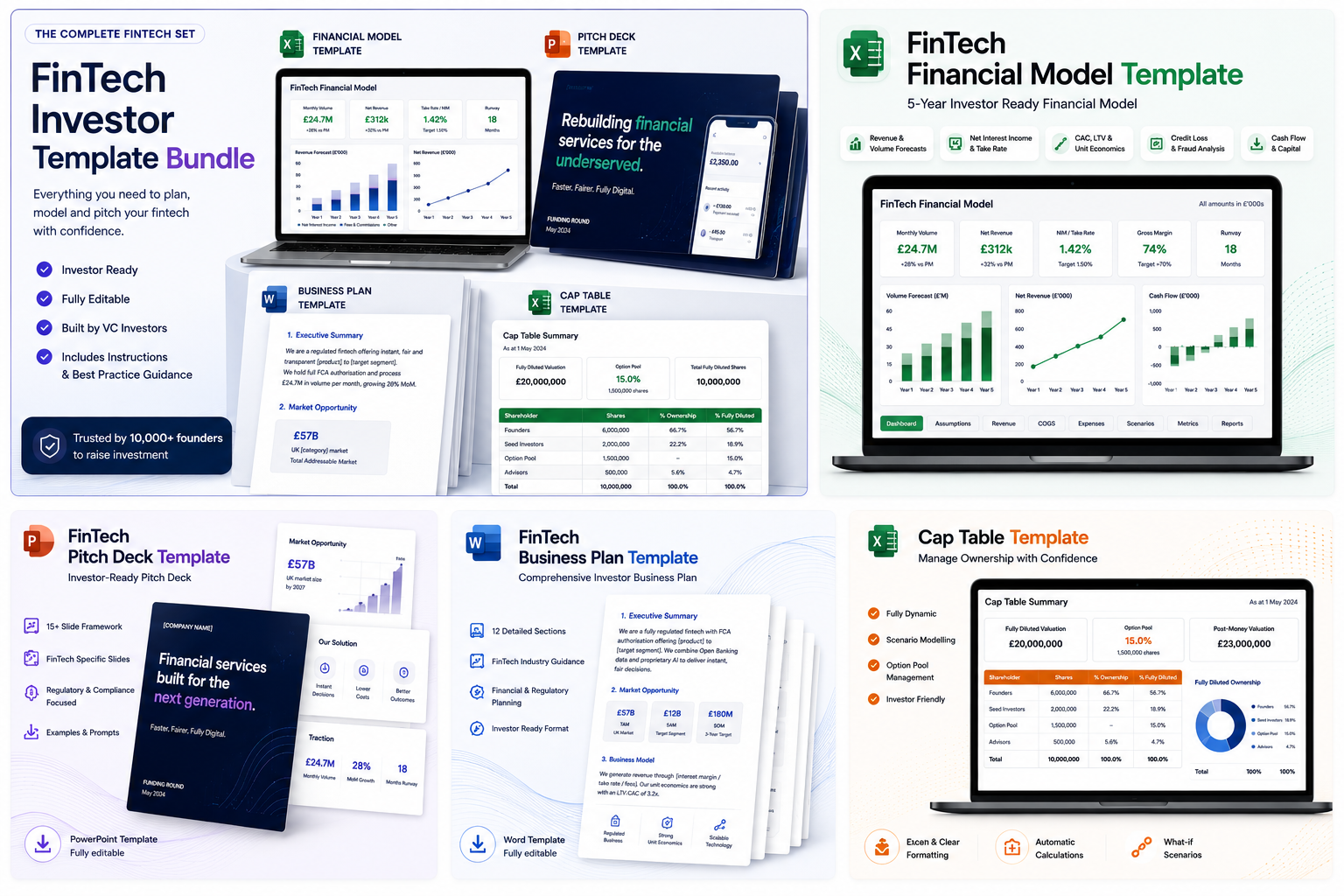
A complete fundraising document package for fintech startups in lending, payments, insurance, or embedded finance, containing four investor-ready templates: a pitch deck built around the regulated financial product investment thesis, a 5-year financial model structured for take rate or NIM revenue, a business plan covering FCA regulatory strategy and Open Banking, and a cap table covering equity and debt+equity mixed round scenarios.
What’s in the package
| Pitch Deck Template | 5-Year Financial Model | Business Plan Template | Cap Table Template |
| 19-slide fintech investor deck | NIM / take rate model | Fintech-specific 12 sections | Equity + debt scenarios |
| Regulatory moat narrative | Credit loss in COGS | FCA authorisation section | Regulatory capital note |
| Embedded distribution story | Compliance cost structure | Open Banking strategy | Exit comparables |
| Instant download | Instant download | Instant download | Instant download |
Who is this for?
Founders of FCA-authorised and unregulated fintech startups – lending platforms, payment processors, insurance technology, embedded finance providers, Open Banking applications, and digital wealth managers – at pre-seed through to Series B. Also suitable for founders preparing materials for an FCA application or a first institutional equity round.
Why is this different from other templates?
Fintech has a compliance dimension that no other startup sector has: you cannot operate without regulatory permissions, and investors know that FCA authorisation is both a barrier to entry and a signal of founder credibility. This package includes a business plan section specifically covering your FCA regulatory strategy, a financial model that accounts for compliance costs and credit/fraud provisions, a pitch deck that turns regulatory status into a competitive moat narrative, and a cap table that models both equity and debt components of a typical fintech raise.
What each document contains
📊 Fintech Pitch Deck Template
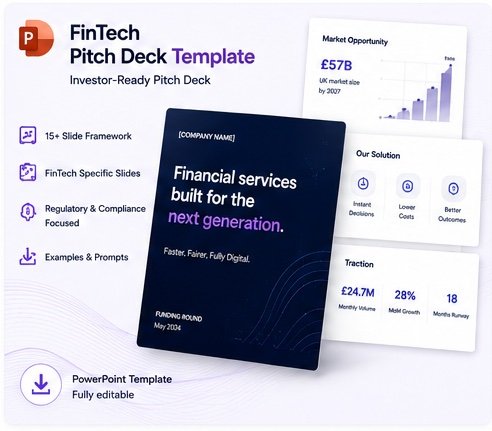
A 19-slide deck structured for fintech fundraising: the underserved customer and legacy infrastructure problem, your digital-first regulated product and decisioning speed, net interest margin or take rate business model, Open Banking data advantage, market size by transaction volume or loan book, FCA authorisation as a competitive moat, team with financial services and regulatory credentials, default/fraud rate traction, and the bank acquisition or IPO exit story. Fully editable in PowerPoint.
📈 Fintech Financial Model
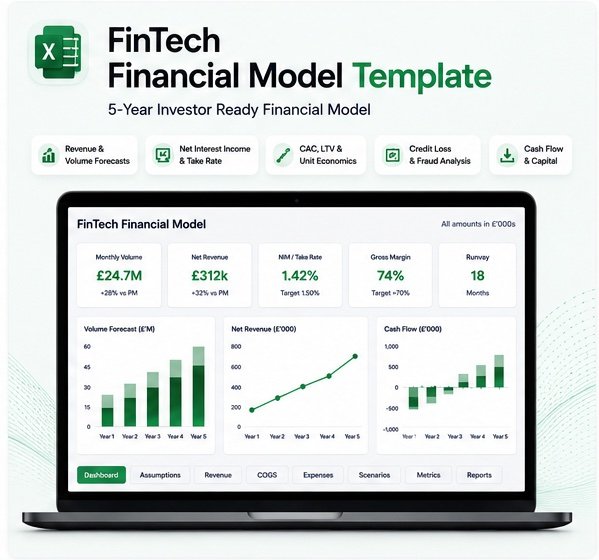
A 22-sheet Excel model structured for fintech economics: net revenue per customer (take rate or NIM) as the revenue driver, funding cost and credit/fraud loss in COGS, FCA compliance and AML technology in overheads, core banking and KYC infrastructure costs, regulatory and compliance team in the staffing plan, and a 5-year P&L reflecting the capital-intensive early phase of a fintech business. All assumptions adjustable in the Build Sheet.
📄 Fintech Business Plan
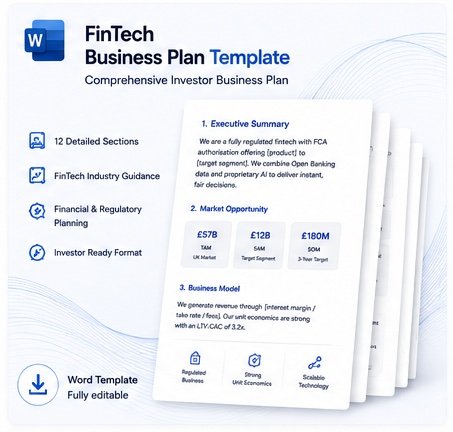
A 12-section business plan covering fintech-specific considerations throughout: FCA regulatory strategy and authorisation pathway, Consumer Duty compliance framework, AML and KYC programme, Open Banking data and distribution strategy, credit model and underwriting approach, funding line structure (for lenders), embedded finance partnership strategy, and comparable fintech exit transactions (bank acquisitions, PE deals, IPOs).
📋 Cap Table Template
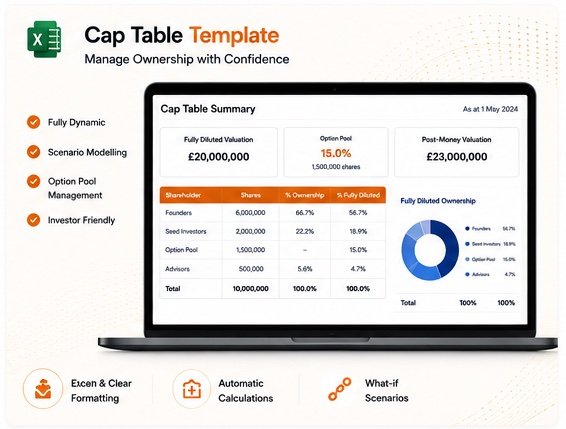
A cap table structured for fintech equity rounds: founder shares, angel round, Seed equity round with SEIS/EIS modelling (where eligible), Series A, regulatory capital allocation note, debt facility alongside equity (for lenders), ESOP for risk and engineering talent, and a dilution waterfall showing investor returns at exit multiples.
Format & delivery
All four documents delivered as instant downloads: PowerPoint (.pptx), Excel (.xlsx), Word (.docx), and Excel (.xlsx). Compatible with Microsoft Office 2016+, Google Workspace.
FAQ Section
Add as accordion or text block at the bottom of the product page. Each question targets a specific long-tail search query.
Why do I need a fintech-specific package rather than a generic startup bundle?
Fintech businesses have economics that generic templates simply don’t capture: net interest margin vs take rate vs subscription revenue, credit loss as a cost of revenue, regulatory capital as part of the funding requirement, and FCA authorisation as both a cost and a competitive moat. All four documents in this package are structured around these dynamics.
Does the business plan cover FCA authorisation?
Yes. The business plan includes a dedicated regulatory strategy section covering FCA authorisation (or exemption), regulated activities, Consumer Duty obligations, AML/CTF programme, and ongoing regulatory reporting requirements. You adapt this to your specific regulatory permissions and business model.
Can I model a debt facility alongside equity in the cap table?
Yes. The cap table includes a section for debt facility alongside equity, which is typical for lending fintechs that raise equity capital alongside a warehouse or revolving credit facility. The equity dilution model covers only the equity component.
Is the financial model suitable for a payments business with a take rate model?
Yes. The revenue per customer line represents your net revenue per active customer per year – for a payments business, this is your net take rate applied to average transaction value per customer. The model is equally suitable for lending (NIM model), payments (take rate), insurance (net premium), and subscription fintech.
Does the package cover SEIS/EIS eligibility for fintechs?
FCA-regulated financial services businesses are generally excluded from SEIS/EIS. The cap table includes a note on this, and the business plan covers alternative structures for fintech fundraising. Unregulated fintech businesses may be eligible – always confirm with your tax advisor.