Overview
Healthtech investors are a different breed. They evaluate clinical evidence before commercial traction, regulatory status before revenue, and NHS adoption before scale. A generic startup template that shows ‘users’ as the revenue unit, ignores MHRA registration, and has no line for regulatory affairs costs signals that the founder doesn’t understand how healthcare technology is procured, evaluated, and acquired. This package is built specifically for healthtech and MedTech founders who need investor documents that reflect the clinical, regulatory, and commercial realities of selling into the NHS and private healthcare.
What is it?
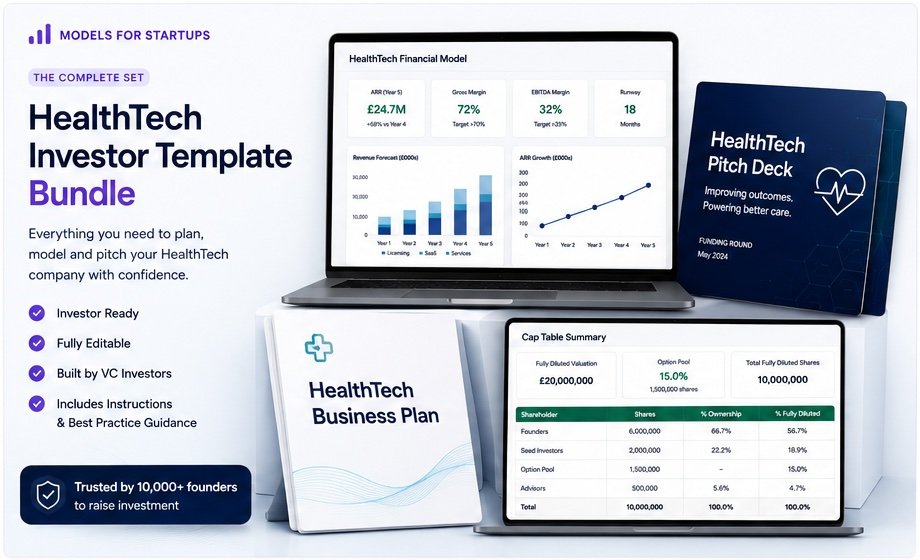
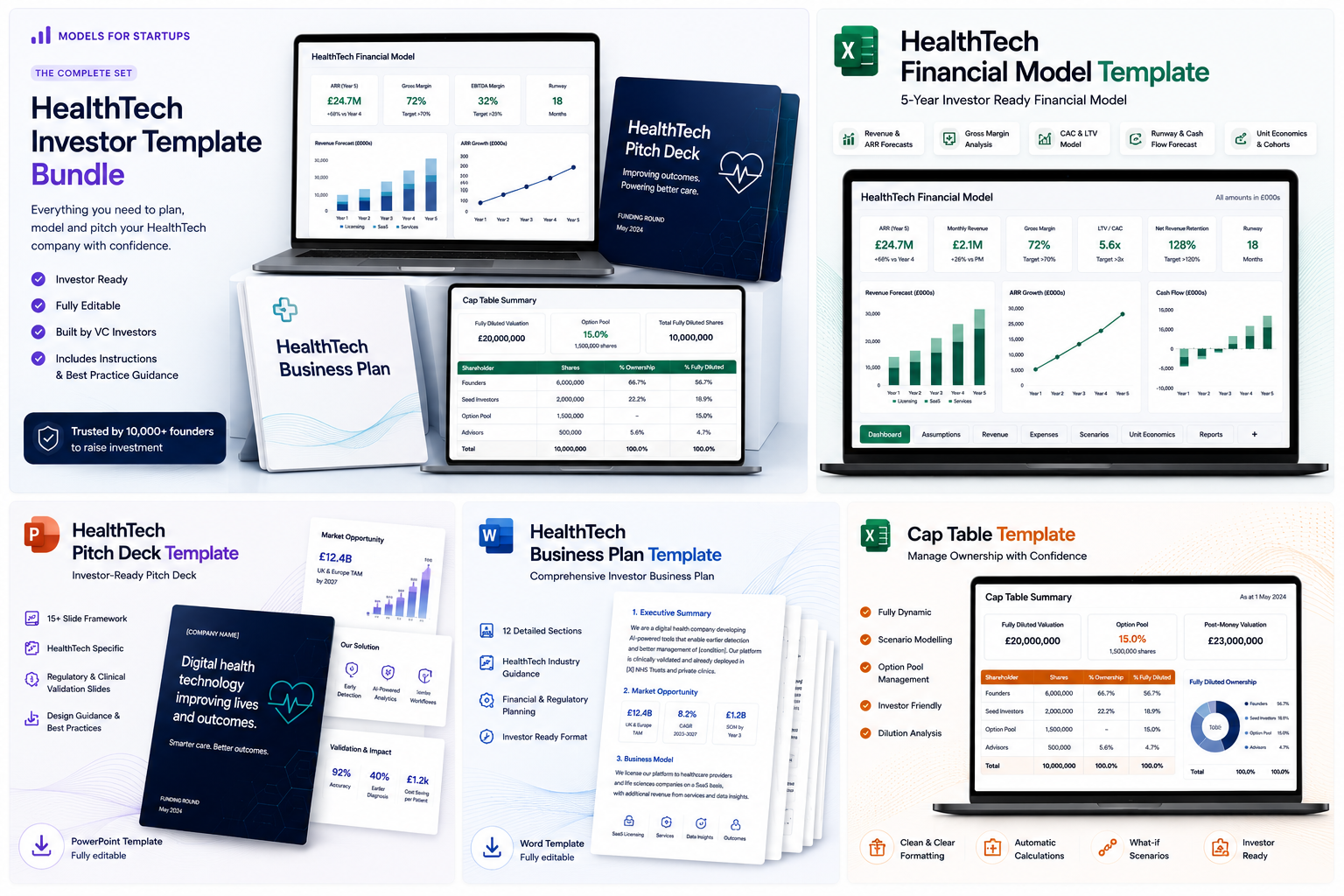
A complete fundraising document package for digital health, MedTech, and clinical software startups, containing four investor-ready templates: a pitch deck built around the NHS clinical adoption story and MedTech exit, a 5-year financial model structured for NHS site contracts and clinical revenue, a business plan covering MHRA regulatory strategy, NICE evaluation, and NHS procurement, and a cap table covering Seed and grant+equity scenarios.
What’s in the package
| Pitch Deck Template | 5-Year Financial Model | Business Plan Template | Cap Table Template |
| 19-slide healthtech deck | NHS site revenue model | Healthtech-specific 12 sections | Seed + grant scenarios |
| Clinical evidence narrative | Regulatory cost structure | MHRA & NICE strategy | NHS grant alongside equity |
| NHS procurement story | AHSN & conference budget | Clinical evidence plan | MedTech exit comparables |
| Instant download | Instant download | Instant download | Instant download |
Who is this for?
Founders of digital health, clinical software, software as a medical device (SaMD), diagnostics, remote monitoring, and MedTech businesses targeting NHS Trusts, Integrated Care Boards, private healthcare operators, or international health systems – from Seed through to Series B. Also suitable for founders preparing for NICE evaluation, MHRA submission, or an Innovate UK grant application who need to update their investor materials.
Why is this different from other templates?
Healthtech investors understand that two NHS Trust contracts can represent a more fundable business than twenty SaaS customers – because of the ACV, the clinical evidence generated, the procurement barrier to competition, and the path to national rollout. This package is structured around that logic: the pitch deck tells the NHS adoption and regulatory milestone story, the financial model uses contracted sites as the revenue unit, the business plan covers the full regulatory pathway from DTAC to NICE, and the cap table models Innovate UK and NIHR grants alongside equity.
What each document contains
📊 Healthtech Pitch Deck Template
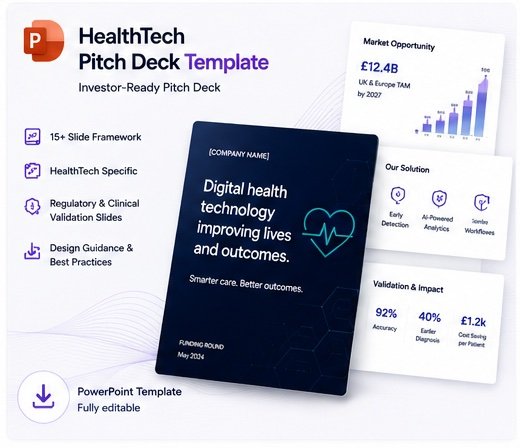
A 19-slide deck structured for healthtech fundraising: the clinical problem and NHS capacity crisis, your digital health or MedTech solution and clinical evidence, DTAC compliance and EHR integration as adoption accelerators, NHS ACV and contract model, MHRA regulatory status as a competitive moat, AHSN distribution and clinical champion strategy, team with clinical, regulatory, and commercial credentials, traction (contracted sites, patients through system, clinical outcomes), and the MedTech or pharma acquisition exit story. Fully editable in PowerPoint.
📈 Healthtech Financial Model
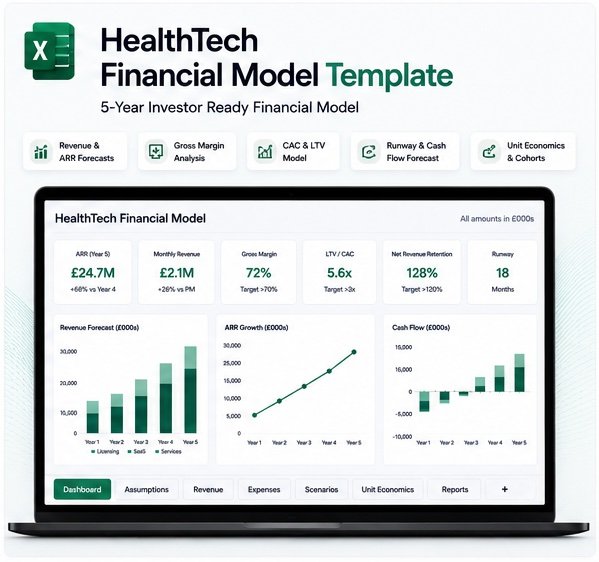
A 22-sheet Excel model structured for NHS and private healthcare economics: contracted sites as the revenue unit, annual contract value per site as the revenue driver, regulatory affairs and clinical contractors as a significant overhead, NHS conference and AHSN partnership costs in the budget, clinical platform infrastructure in IT costs, and a 5-year P&L reflecting the slow initial contracting pace and high ACV per site of NHS business. All assumptions adjustable in the Build Sheet.
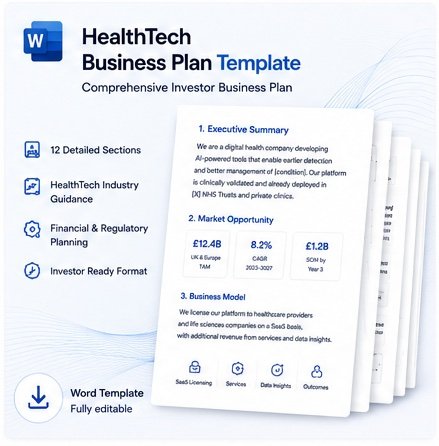
📄 Healthtech Business Plan
A 12-section business plan covering healthtech-specific considerations throughout: MHRA medical device registration and regulatory pathway, DTAC compliance and NHS Digital standards, NICE Medtech Innovation Briefing strategy, NHS procurement routes (G-Cloud, NHS Supply Chain, direct award, competitive tender), AHSN partnership model, clinical champion network development, ISO 13485 quality management system, health economics evidence plan, and MedTech and pharma comparable acquisition transactions.
📋 Cap Table Template
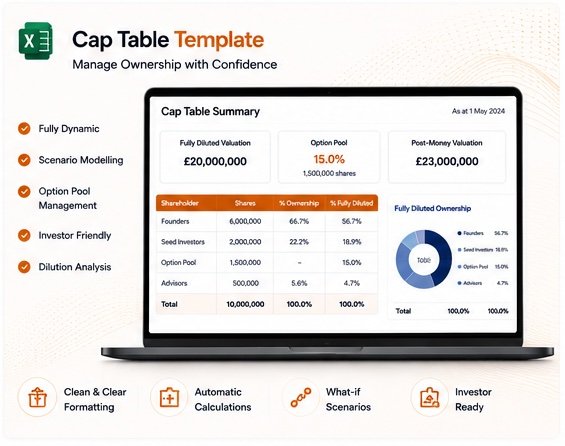
A cap table structured for healthtech equity rounds: founder shares, angel or Seed round, Innovate UK / NIHR grant as non-dilutive income alongside equity, Series A with healthcare specialist investors, ESOP for clinical, regulatory, and engineering talent, and a dilution waterfall showing investor returns at MedTech revenue multiples. Includes a note on university spin-out IP licence considerations.
Format & delivery
All four documents delivered as instant downloads: PowerPoint (.pptx), Excel (.xlsx), Word (.docx), and Excel (.xlsx). Compatible with Microsoft Office 2016+, Google Workspace.
FAQ Section
Add as accordion or text block at the bottom of the product page. Each question targets a specific long-tail search query.
Why do I need a healthtech-specific package rather than a generic startup bundle?
Healthtech businesses have a regulatory, clinical, and commercial structure that generic templates simply don’t reflect: contracted sites as the revenue unit, MHRA registration as a prerequisite for NHS procurement, regulatory affairs as a significant fixed cost, and NHS procurement timelines that mean slower early revenue than a software company. All four documents in this package are structured around these realities.
Does the business plan cover the MHRA regulatory pathway?
Yes. The business plan includes a dedicated regulatory strategy section covering MHRA medical device classification (Class I, IIa, IIb), software as a medical device (SaMD) requirements, UKCA marking, technical file preparation, and ongoing post-market surveillance obligations. You adapt this to your specific device classification.
Can I model Innovate UK or NIHR grant income in the cap table?
Yes. The cap table includes a section for non-dilutive grant funding alongside equity, which is common for early-stage healthtech companies. This allows you to show investors the total funding picture including grant income without including it in the equity dilution calculation.
Is the financial model suitable for a company selling to both NHS and private healthcare?
Yes. The model uses two revenue lines that can represent NHS Trust contracts (Line 1, higher ACV, slower growth) and private clinic or international revenue (Line 2, different pricing and growth rate). You set the assumptions for each channel separately in the Build Sheet.
Does the pitch deck include a slide on NHS procurement routes?
Yes. The pitch deck includes a growth strategy slide that covers NHS procurement routes – G-Cloud, NHS Supply Chain, direct award, and competitive tender – as well as the AHSN distribution model. This is a key area of investor due diligence in healthtech and addressing it proactively in the deck demonstrates commercial understanding.