Overview
Marketplace investors understand one thing above all others: the chicken-and-egg problem. Before they write a cheque, they need to see that you have a credible plan for building supply and demand simultaneously, that your unit economics work at the transaction level, and that network effects will make the platform more defensible over time. A generic startup template that doesn’t distinguish between GMV and net revenue, or that ignores the dual-sided cost structure, signals that the founder hasn’t yet thought rigorously about marketplace economics. This package is built for marketplace founders who want to walk into investor meetings with materials that show exactly this thinking.
What is it?
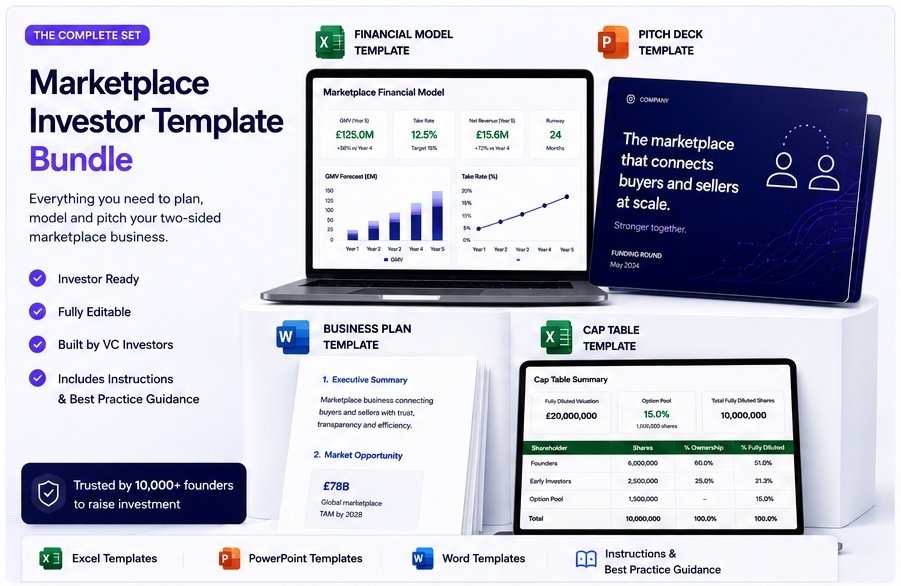
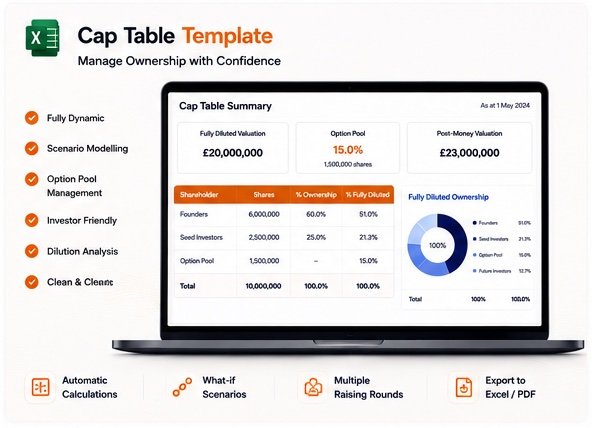
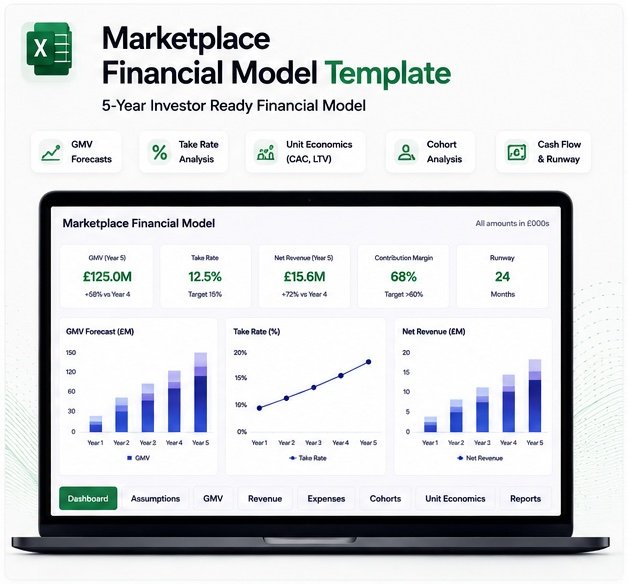
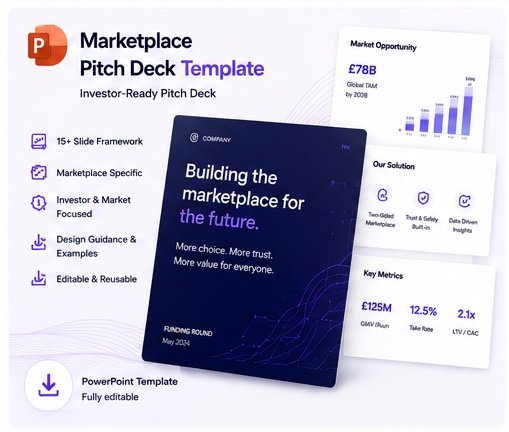
A complete fundraising document package for two-sided marketplace businesses, containing four investor-ready templates: a pitch deck built around marketplace dynamics and the network effects story, a 5-year financial model structured for GMV and take rate economics, a business plan covering supply acquisition, demand generation, and trust and safety, and a cap table covering Seed and Series A scenarios.
What’s in the package
| Pitch Deck Template | 5-Year Financial Model | Business Plan Template | Cap Table Template |
| 19-slide marketplace deck | GMV & take rate model | Marketplace-specific 12 sections | Seed + Series A scenarios |
| Network effects narrative | Dual-side CAC structure | Supply & demand strategy | ESOP for ops team |
| Liquidity story | Trust & safety COGS | Liquidity milestone plan | Dilution waterfall |
| Instant download | Instant download | Instant download | Instant download |
Who is this for?
Founders of two-sided marketplace businesses – B2B procurement, professional services, home services, logistics, healthcare, staffing, or consumer marketplaces – at pre-seed through to Series A. Also suitable for founders preparing to demonstrate marketplace liquidity milestones ahead of a follow-on round.
Why is this different from other templates?
Marketplace investors have a specific framework for evaluating platforms: supply quality, demand liquidity, take rate sustainability, and the network effect that makes the platform more valuable with scale. This package addresses all four – the pitch deck tells the liquidity and network effects story, the financial model shows GMV and net revenue separately, the business plan covers supply-first strategy and trust and safety, and the cap table shows a realistic path to the strategic acquisition or PE exit that marketplace businesses typically target.
What each document contains
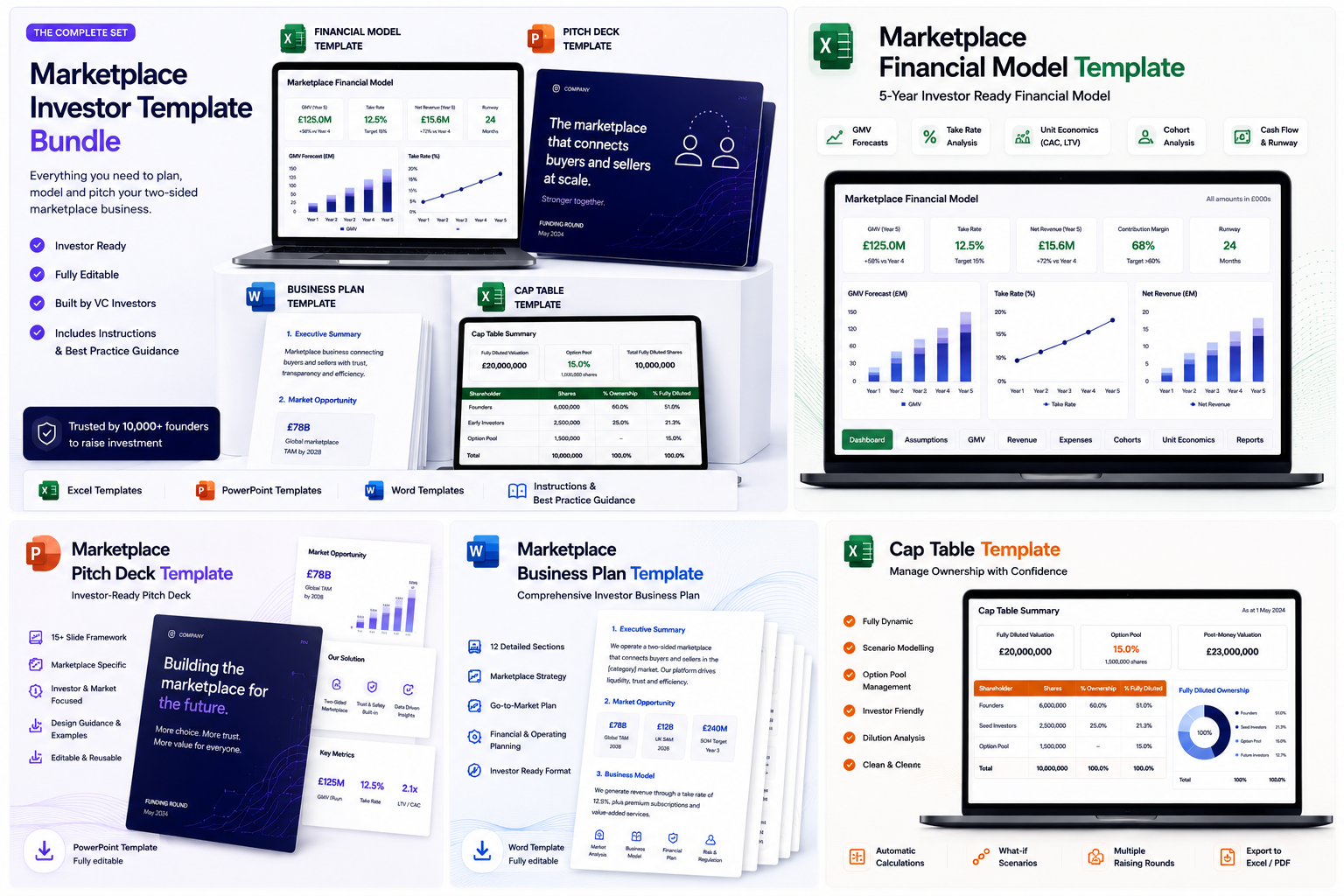
📊 Marketplace Pitch Deck Template
A 19-slide deck structured for marketplace fundraising: the fragmented, offline, or trust-deficient market, your two-sided platform and the verified supplier/buyer matchmaking model, GMV and take rate business model, supply acquisition and verification strategy, demand generation and buyer CAC, network effects mechanism, competition against offline and generic digital alternatives, team with marketplace and operations credentials, traction metrics (GMV, active buyers, active suppliers, repeat transaction rate), and the strategic acquisition or PE exit story. Fully editable in PowerPoint.
📈 Marketplace Financial Model
A 22-sheet Excel model structured for marketplace economics: net revenue per buyer (take rate applied to average transaction value) as the revenue driver, payment processing and trust and safety costs in COGS, demand generation advertising and supply acquisition operations in overheads, and a 5-year P&L showing the path from early liquidity to scale. All assumptions adjustable in the Build Sheet.
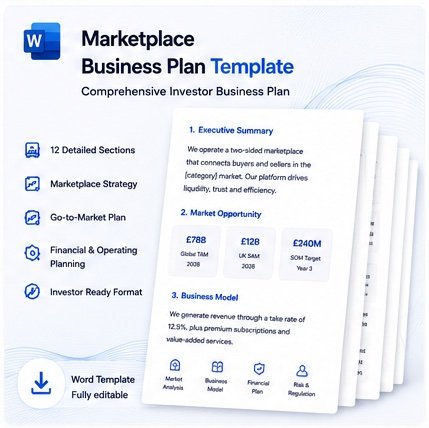
📄 Marketplace Business Plan
A 12-section business plan covering marketplace-specific considerations: supply-first launch strategy and geographic focus, supplier verification and quality standards, buyer acquisition and demand generation channels, trust and safety framework (escrow, insurance, dispute resolution), take rate evolution strategy, disintermediation risk and mitigation, network effects mechanism and flywheel description, and comparable marketplace exit transactions.
📋 Cap Table Template
A cap table structured for marketplace equity rounds: founder shares, angel or pre-seed round, Seed round with SEIS/EIS modelling, Series A with new investor pool, ESOP for operations and growth team, and a dilution waterfall showing investor returns at GMV-based or revenue-based exit multiples.
Format & delivery
All four documents delivered as instant downloads: PowerPoint (.pptx), Excel (.xlsx), Word (.docx), and Excel (.xlsx). Compatible with Microsoft Office 2016+, Google Workspace.
FAQ Section
Add as accordion or text block at the bottom of the product page. Each question targets a specific long-tail search query.
Why do I need a marketplace-specific package?
Marketplace businesses have economics that generic templates don’t capture: the distinction between GMV and net revenue, dual-sided acquisition costs, trust and safety as a cost of revenue, and the liquidity challenge of building supply and demand simultaneously. All four documents in this package are structured around these marketplace-specific dynamics.
How does the financial model handle GMV vs net revenue?
The Revenue per Buyer line in the financial model represents your net revenue per active buyer per year – your GMV per buyer multiplied by your blended take rate. GMV can be calculated externally by dividing net revenue by your take rate. We include guidance on how to present both GMV and net revenue clearly to investors.
Can I model both buyer-side and supplier-side revenue in the financial model?
Yes. The model has two revenue lines that can represent different revenue streams – buyer transaction fees as Line 1 and supplier subscription or listing fees as Line 2 – with separate margin assumptions for each.
Is this suitable for a B2B procurement marketplace?
Yes. The templates are structured to work for both B2C and B2B marketplace models. The pitch deck and business plan include language adaptable to B2B buyer personas (procurement managers, operations directors) and B2B supplier types (manufacturers, service providers, specialists).
Does the package cover disintermediation risk?
Yes. The business plan includes a dedicated section on disintermediation risk – the risk that buyers and suppliers transact directly after meeting on the platform – and the tactics used to mitigate it (managed payments, trust tools, platform-only dispute resolution, and subscription incentives).